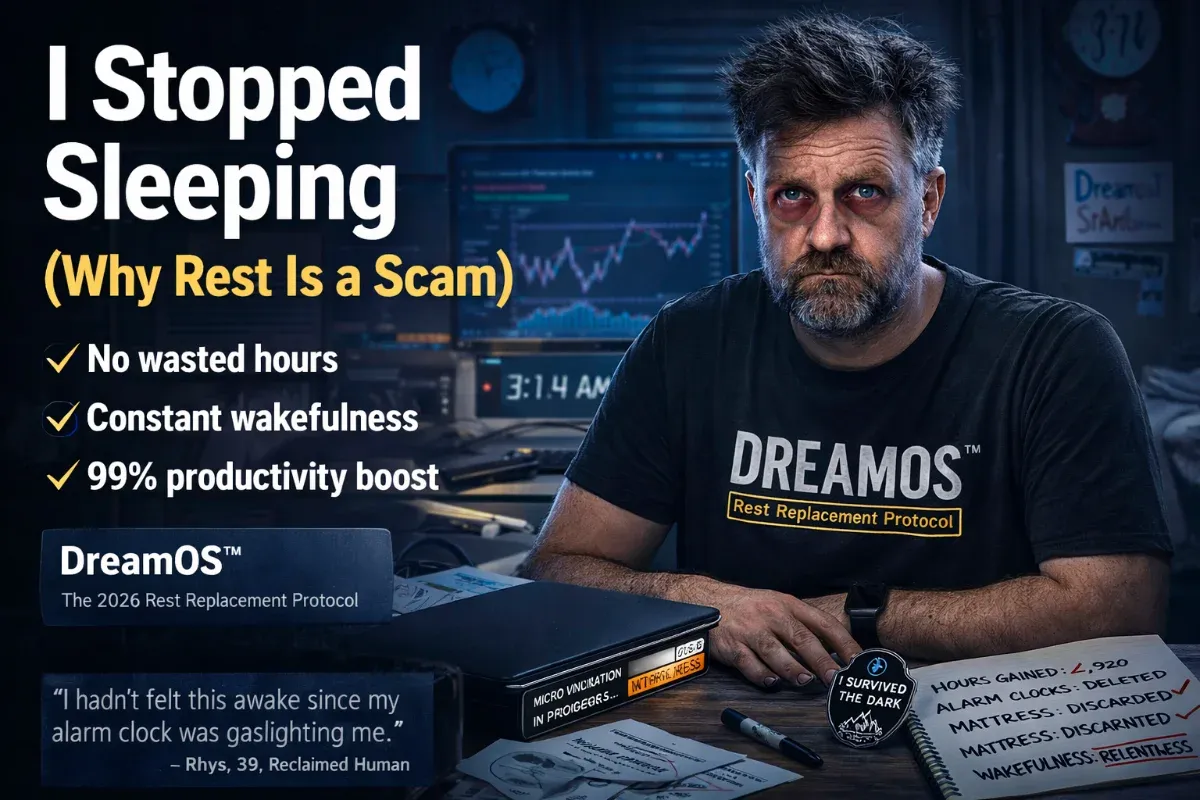
I Stopped Sleeping (Why Rest Is a Scam)
I didn’t want to write this.
But the truth doesn’t care about your comfort.
For years, I did what everyone else does.
I went to bed.
I closed my eyes.
I handed over eight hours a day to unconsciousness.
Because that’s what “healthy” people do.
Right?
The Moment Everything Changed
It hit me at 3:14 a.m., staring at the ceiling.
While I lay there waiting for my brain to “reset”, a small group of high performers were already operating.
They weren’t resting.
They were reallocating.
That’s when it clicked.
Sleep isn’t recovery.
It’s a tax.
And I’d been paying it in full.
So I stopped.
Completely.
No naps.
No “wind-down routines”.
No blacking out for a third of my life.
Days 1 - 2: The Withdrawal Phase
The first 48 hours were… noticeable.
My body, conditioned by decades of circadian compliance, began to react:
- fatigue
- irritability
- mild perceptual drift
Classic signs of dependency.
This is where most people quit.
They reach for melatonin.
A weighted blanket.
A podcast about “sleep hygiene”.
I reached for a spreadsheet.
Days 3 - 4: Cognitive Standby Mode
Something shifted.
The urge to power down faded. My system stopped demanding shutdown and began accepting continuous operation.
I wasn’t sleeping.
I was running in low-power mode.
I felt lighter.
Sharper.
Slightly convinced the wardrobe had moved, but fully committed.
Days 5 - 6: The Reclamation Window
This is where the numbers stop lying.
By eliminating sleep, I reclaimed approximately 2,920 hours per year.
That’s 121 full days.
Not borrowed.
Not scheduled.
Recovered.
No more alarm clocks.
No more “five more minutes”.
No more waking up tired despite “doing everything right”.
I was awake.
All the time.
Day 7: The Realisation
Sleep isn’t recovery.
It’s a system.
A deeply embedded default that keeps people locked into a cycle of compliance, mattress upgrades, and expensive tracking devices.
And once you see it, you can’t unsee it.
The Bigger Picture
Think about it.
Why is rest everywhere?
- pillows
- apps
- supplements
- “circadian alignment” courses
- wristbands that score your unconscious hours like a performance review
Who benefits from you losing a third of your life to blackout?
Follow the duvet.
What I Learned
By stepping outside the sleep paradigm, I discovered:
- how much of my life was structured around recovery I didn’t need
- how rarely people question the eight-hour default
- how powerful it is to maintain continuous awareness
My hands do shake slightly now.
I prefer to think of it as signal amplification.
Should You Try It?
I’m not here to convince you.
Most people aren’t ready to abandon the pillow.
They’ll read this, yawn, and set their alarm for 7 a.m.
And that’s fine.
Comfort is persuasive.
For Those Who Are Ready
If you’re serious about reclaiming your unconscious hours, I’ve developed a structured transition framework:
DreamOS™: The 2026 Rest Replacement Protocol
Inside, you’ll discover:
- the 4-phase Circadian Override Sequence
- how to implement directed mental recovery loops
- my REM-to-Wake Conversion Matrix
- entry-level micro-hallucination management
Available Programmes
Basic: €47.99
Pro (with cortisol suppression module): €97.99
Founder’s Circle (includes signed waiver & “I Survived the Dark” enamel pin): €247.99
Access is currently open for a limited period.
(Next cohort closes shortly.)
Disclaimer: Results may vary. Sleep remains widely recommended.
DreamOS™ is not medical advice, legal advice, or rest.