The Sacred Potato and the £47 Checkout Page
Six potatoes. Forty-seven pounds. Ceremonial water sold separately. A brief investigation into what happens when wellness marketing gets hold of a vegetable.
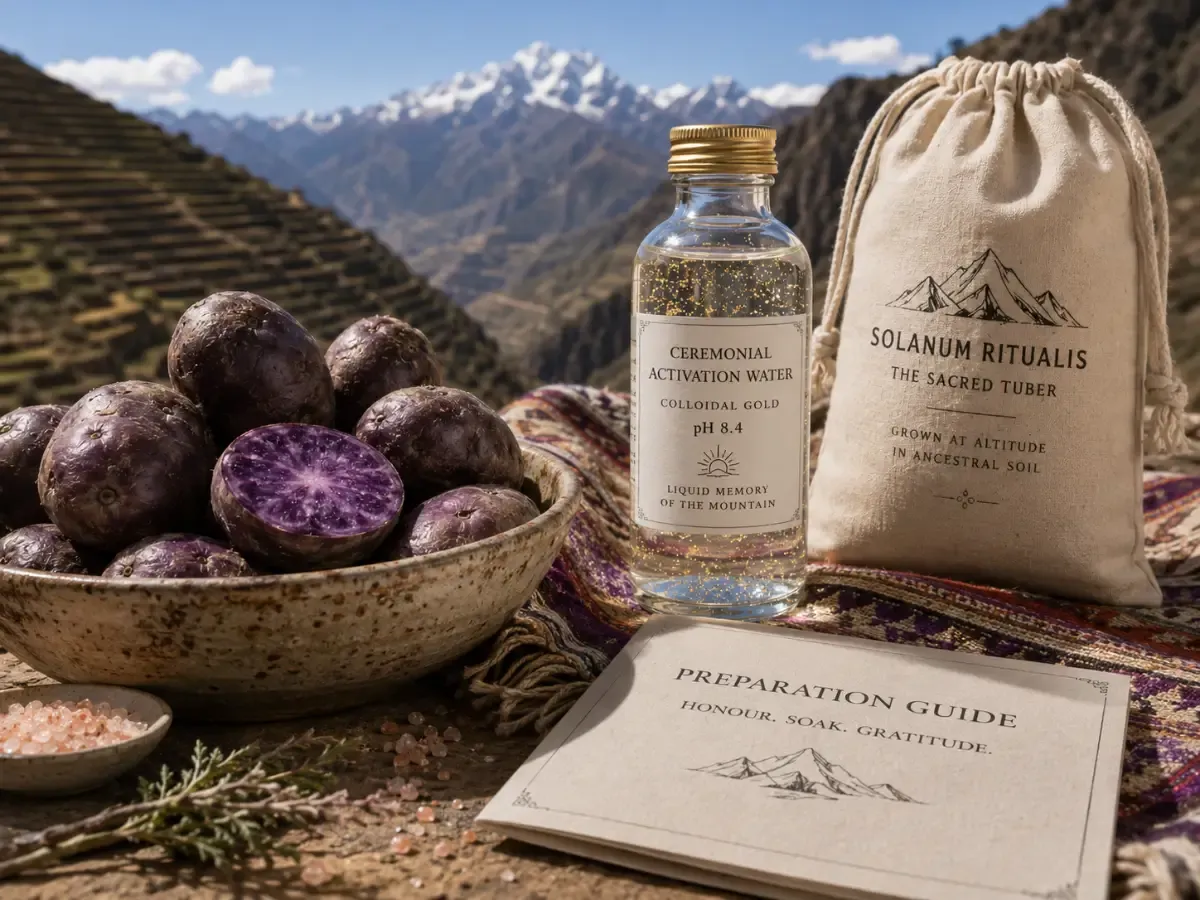
There is a potato.
This should not be complicated.
It grows in the ground. You dig it up. You wash it. You cook it. If you are Welsh, Irish, Peruvian, Northern European, or merely hungry, you already understand the basic arrangement. Humanity and the potato have had a long and productive relationship. It has got us through wars, winters, famines, school dinners, late-night hunger, and the emotional wreckage of realising there is nothing in the house except a bag of spuds and half a block of cheese.
The potato has done enough.
It does not need a rebrand.
Unfortunately, the wellness industry has never met a perfectly ordinary food it could not spiritually overinflate, wrap in linen, photograph at dawn, and sell at a 4,000 percent markup.
Which brings us to the Sacred Purple Andean Tuber.
It is purple.
It is ancestral.
It is cultivated at altitude.
It costs £47 for six.
This is not a typo. Six potatoes. Forty-seven pounds. Not a sack. Not a crate. Not enough to feed a village, a retreat, or even a particularly committed family with a fondness for mash. Six.
The product copy, naturally, does not call them potatoes. That would be vulgar. It calls them tubers, roots, vessels, carriers of soil memory, and, at one particularly difficult moment, “living archives of ceremonial nourishment.”
This is wellness language doing what wellness language does best: standing between you and common sense while wearing expensive linen.
The potato, we are told, descends from ancient Andean agricultural traditions. It is grown in soil described as ancestral, at an altitude where the air is thin, the sunlight is pure, and the marketing department has clearly been left unsupervised.
The farmers are said to follow protocols passed down over thousands of years. The Inca are mentioned often enough to add glamour, but not so often that anyone has to deal with the less photogenic parts of the history.
This is important. The wellness industry loves ancient civilisations, but only after a careful edit.
Temples, yes.
Ceremony, yes.
Wisdom, absolutely.
Human sacrifice, imperial conquest, child offerings, disease, hunger, class systems, and all the other messy bits of real history? Less so. Those are usually filed under “complexity” and moved quietly to the footer.
What remains is a mood board.
A mountain. A woven cloth. A woman in loose natural fibres holding a potato with the expression of someone receiving a transmission from the soil, or perhaps struggling with altitude sickness.
The founder’s story follows the familiar pattern. She had worked in brand strategy, possibly for a vegan meal kit company with a name like Rootly or KindBowl. Then came burnout. Then came disconnection. Then came the retreat in Peru, because apparently no one can recover from modern life in a Travelodge near Swindon.
There, according to the origin story, she encountered the purple tuber.
She held it.
Something shifted.
This phrase, “something shifted,” should now be treated as a financial warning. Whenever something shifts in wellness copy, someone is about to sell you water.
And sure enough, the potato is only the beginning.
Before eating the Sacred Purple Andean Tuber, you must activate it.
This is where the ordinary person might become confused. A potato, in the traditional model of potato engagement, is activated by heat. You boil it, bake it, roast it, fry it, or, in moments of despair, microwave it and pretend everything is fine. The potato becomes edible. Job done.
But this is not that sort of potato.
This potato has ceremonial memory.
It has ancestral intelligence.
It has an energetic profile.
It is, apparently, sulking.
Your supermarket potato, by contrast, is inert. It has been grown in compromised soil, harvested by machinery, stored in warehouses, and sold in a bag that has never once been blessed beneath the Andean sun. You have been eating spiritually unavailable potatoes your entire life.
This explains, we are told, a great deal.
Does it?
Does it explain the collapse of public trust? The cost of living crisis? LinkedIn? The fact that people now describe drinking water as “hydration practice”? Possibly not. But it does explain why the Sacred Tuber requires a preparation guide.
The preparation begins with soaking.
Not in tap water. Don’t be disgusting.
The potato must be soaked in pH-adjusted ceremonial water. This water, available separately, costs £34 for 500 ml. It has allegedly been calibrated to match the alkalinity of ancient Andean glacial meltwater during the height of the Incan empire.
How anyone knows the precise pH of 15th-century glacial meltwater is not made clear. Perhaps it was written down by a priest. Perhaps it came in a dream. Perhaps someone in the office said “8.4 sounds scientific” and everyone nodded because the product launch was on Tuesday.
The water also contains colloidal gold.
Not enough gold to be useful. Not enough gold to see. Not enough gold to taste. Not enough gold to sell during a financial emergency. Just enough gold to appear in the ingredients list, where it can perform its true function, which is to make water expensive.
There is also a colloidal silver option for those who feel their potato requires antimicrobial support, and a gold-silver blend described as “the full Incan spectrum.” This costs more, obviously, because nothing says ancestral simplicity like precious metals suspended invisibly in bottled water.
Once submerged, the tuber must soak for exactly four hours.
Not three.
Not five.
Four.
This, the guide explains, corresponds to the four cardinal directions of Incan cosmology: North, South, East, and West. These are also the cardinal directions of leaving the kitchen, going to the supermarket, buying normal potatoes, and returning with your dignity intact.
During the soak, artificial lighting should be kept to a minimum. The potato is said to be sensitive to fluorescent environments, which can disrupt the reactivation of ancestral cellular intelligence.
You may play ceremonial music. A recommended playlist is available through a subscription service, which is separate from the potato, the water, the salt, the cloth, the course, the community, and your dwindling patience.
You are also invited to express gratitude.
This is where wellness marketing becomes clever. Gratitude is good. Mindfulness can be useful. Eating slowly, noticing where food came from, and remembering that agriculture is hard work are all perfectly decent ideas. There is nothing wrong with pausing for a moment before a meal and acknowledging that food does not magically appear.
The trick is to take a real and reasonable thing, then attach it to a checkout page.
The potato becomes not just food, but a ritual. The ritual becomes not just preparation, but transformation. The transformation becomes not just metaphor, but product architecture.
And product architecture always expands.
There is the potato.
Then there is the water.
Then the flour.
Then the activation kit.
Then the private online community.
Then the founder’s circle.
Then the monthly subscription.
Then the certificate, suitable for framing, confirming that you are now a Conscious Tuber Practitioner.
This is how modern wellness works. It never sells you one thing when it can sell you a ladder.
The first rung is affordable enough to feel whimsical. The second makes the first seem incomplete. The third introduces community. The fourth adds identity. By the time you reach the top, you are not buying potatoes. You are participating in a story about yourself.
You are not a customer.
You are a person who has awakened to root wisdom.
You have left inert carbohydrates behind.
You have joined The Root Circle.
Your friends may not understand. This is because they are blocked, closed, cynical, or married to someone who points out that you have paid £34 for water with invisible gold in it. Such people are not ready to receive.
The testimonials are exactly what you would expect.
One woman reports feeling warmth in her hands during the soak. Another accidentally soaked her tuber for five hours and is worried she may have offended one of the cardinal directions. A man in his sixties says he has been eating potatoes wrong his entire life, which is a hard thing to discover after retirement but still cheaper than a sports car.
The potato itself, when cooked, tastes like a potato.
This is presented not as a problem, but as proof of subtlety.
The nutritional claims are similarly slippery. Purple potatoes do contain anthocyanins, which are antioxidants also found in other purple and red foods. They contain potassium. They contain vitamin C. They contain complex carbohydrates. In other words, they contain many of the things potatoes contain.
This is the kernel of truth, and every good wellness grift needs one.
The potato is real.
The history of Andean potato cultivation is real.
The nutritional value of purple-pigmented foods is real.
The farmers are probably real.
The altitude may well be real.
The nonsense is built around the real thing, not instead of it. That is what makes it effective. Nobody is selling pure fantasy. They are selling a potato surrounded by enough truth to make the fantasy feel respectable.
That is the genius of it.
You start with something solid and humble. Then you mist it with ancient wisdom. You add vague science. You mention bioavailability. You imply that modern life has damaged the customer in a way only your product understands. Then you introduce a ritual, a founder, a story, and a series of upgrades.
By the end, the customer is not asking, “Is this worth £47?”
They are asking, “What if my current potato is failing me?”
That is the business model.
Not the potato. The doubt.
The wellness industry does not simply sell solutions. It manufactures insufficiency.
Your food is not alive enough.
Your nervous system is not regulated enough.
Your sleep is not optimised enough.
Your breathing is shallow.
Your water is dead.
Your breakfast lacks intention.
Your ordinary life is full of invisible errors that only a stranger with a discount code can correct.
Even your potato is not doing enough.
There is something almost impressive about the nerve of it. For centuries, the potato has been one of the great democratic foods. Cheap, filling, adaptable, unpretentious. It can be boiled, mashed, roasted, fried, baked, chipped, curried, stuffed, gratinated, or turned into vodka if civilisation has taken a particularly difficult turn.
It is the opposite of exclusive.
So, of course, someone had to make it exclusive.
The Sacred Purple Andean Tuber is not really about nutrition. It is about status disguised as reverence. It allows the buyer to perform humility through expense. One does not merely eat a potato. One honours the potato. One enters into relationship with the potato. One becomes the kind of person who knows that ordinary potatoes are asleep.
This is not hunger.
This is branding.
And yet, the saddest part is that the potato itself needs none of it. A purple potato is already interesting. The history of potato cultivation in the Andes is genuinely fascinating. Indigenous agricultural knowledge deserves respect. Biodiversity matters. Traditional crops matter. Farmers matter.
That could have been enough.
But “this is an interesting traditional crop with useful nutrients” does not produce the same margin as “your carbohydrate practice has been spiritually compromised since childhood.”
So here we are.
A real potato, buried beneath a fake crisis.
A decent food, inflated into a lifestyle.
A simple tuber, dragged through the warm mud of premium wellness copy until it emerges, exhausted and shrink-wrapped, at £47 for six.
The sensible response is not panic. If you encounter the Sacred Tuber in the wild, remain calm. Do not mock the potato. The potato has done nothing wrong. It did not write the website. It did not invent ceremonial water. It did not describe itself as a vessel of ancestral intelligence. It is an innocent vegetable caught up in events beyond its control.
Buy purple potatoes if you like purple potatoes.
Eat them with gratitude if gratitude improves your lunch.
Support farmers if the supply chain is fair and transparent.
But do not pay extra because someone told you your food needs activating. Do not buy water because it claims to remember a mountain. Do not become a Conscious Tuber Practitioner unless you are prepared for your family to discuss you in lowered voices.
A potato does not require colloidal gold.
Neither do you.
If you want antioxidants, eat red cabbage. If you want potassium, eat a normal potato. If you want ceremony, light a candle and try not to set fire to the tea towel. If you want ancestral wisdom, start with the very old human practice of not being robbed by someone selling magic water.
Wash the potato.
Cook the potato.
Eat the potato.
There. You have completed the activation protocol.
The mountain will survive.
Acknowledgements
Much of the actual potato science referenced herein was drawn from the publicly available research of the Centro Internacional de la Papa in Lima. They are doing the real work. No one there has ever described a tuber as a "vessel of ancestral memory."
Centro Internacional de la Papa in Lima
The Health Risks Associated with Drinking Silver Water
A note for anyone tempted by “silver water”: this is usually just colloidal or ionic silver under a shinier name. It is not a wellness shortcut, and swallowing it is not considered safe or effective by mainstream medical sources. Possible side effects include argyria, a permanent bluish-grey discolouration of the skin, which seems a high price to pay for believing a bottle with a serif font.